
They hope this will help detect multiple registrations, underage voters, and suspicious images. But there are new issues that can be caused by an increase in AI usage, including fake videos, manipulated images and misleading messages.
This comes at a time when there are concerns about suspected AI images discovered in the Voter Register ahead of the 2027 elections.
INEC has found 268,000 questionable instances of voters registering, thanks to its biometric system. Some of these have come from official login details being used. This has raised concerns about how voter registration is being conducted and whether there are monitoring issues.
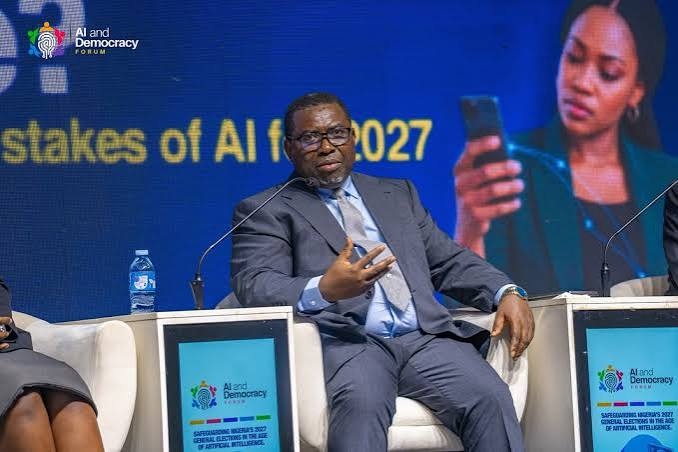
Dr Lawrence Bayode, Director of Information and Communication Technology, INEC, has stated they are using their Automated Biometric Identification System (ABIS) to detect any suspicious cases of multiple registrations and underage voters.
These cases are being investigated further, and INEC is beginning to clean the Voter Register.
Not all images will be taken off, added Bayode. “We will not remove enhanced images; we will just accept those. But if the images are entirely generated through AI, then we will remove them,” he said. Some have allegedly taken advantage of the special process for people with disabilities, specifically those with incomplete fingers.
He encouraged Nigerians to only use official INEC channels to find out about any changes to the election date.
Misinformation
There have been cases of AI misuse recently. During the 20th June 2026 governorship elections in Ekiti State, an image circulated online of voters queuing to sell their votes. This was found to be AI-generated by fact-checkers at the Centre for Democracy and Development.
Another image circulated online was of a high turnout in Ado-Ekiti. This was also found to be an artificial image generated by the Nigerian Fact-Checkers’ Coalition.
This has caused calls for increased monitoring online because of the increased political activity surrounding the 2027 elections.
INEC Chairman, Professor Joash Amupitan, has defended the use of AI and said that it should not be seen as a threat to democracy. Speaking at the Beyond the Ballot Summit in Abuja on the 2nd November, Amupitan said, “AI can help us make elections more efficient. It can help with voter registration, logistics, data analysis and voter databases.”
However, as generative AI becomes more accessible, it can be easier to create realistic fake recordings, replicas of public figures, and misleading messages. It is important that this technology is well managed.
Benefits & Risks of AI
AI can help detect any anomalies and improve the election process, said Oludele Awodele, professor of computer science and artificial intelligence at Babcock University, Ogun State. But it can be misused to create misleading audio, video,o and images, es which can affect a candidate’s reputation.
He recommended watermarking and deepfake detection systems to detect fake images. He also encouraged INEC to work with social media companies to detect and remove misleading messages. Appropriate sanctions should be given to those creating any deceptive AI.
There are risks associated with the technology creating explicit sexual images and videos aimed at female candidates, said Dr Abiola Akiyode-Afolabi, Acting Director of the Safeguarding Centre at the University of Lagos. She explained that AI can be used to stalk women in politics, which can cause them not to vote.
There is currently a law in place called the Violence Against Persons (Prohibition) Act 2015. This does not specifically mention AI but can offer some protection against technologically enabled violence. Protection should be given before, during, and after elections to women and disabled individuals.
Natural language processing can help monitor public dialogue, political speeches, social media, voter complaints and security issues, said Precious Olives, a certified information security professional.
He encouraged INEC, security and civil society groups to create an effective early alert system. He also encouraged technology companies and social media to improve their moderation systems to detect AI-generated misinformation.
Stakeholders discuss AI and the 2027 elections.
Concerns about AI and having credible elections will be discussed during the webinar organised by PUNCH Media Foundation. The webinar will have the title ‘AI, Misinformation and Nigeria’s 2027 Elections: Safeguarding the Truth, Protecting the Vote ‘. The webinar will be online.
The event will take place on Wednesday, the 11th of November, from 11 am to 1 pm West African Time. The event will be attended by media, electoral bodies, security, civil society, ty and technology.
Speakers will include Inspector-General of Police Olatunji Disu, INEC National Commissioner Mohammed Haruna, YIAGA Africa Director of Programmes Cynthia Mbamalu, Cable Newspaper Journalism Foundation Mayowa Tijani, and FactsMatterNG Hannah Ajakaiye.
The webinar will be moderated by Joel Nwokeoma, Metro Editor at The PUNCH.
Experts say AI can play a key role in increasing transparency during the 2027 general elections. It must be monitored, accountable, and human-informed so it can help increase democracy in Nigeria.