

The Joint Revenue Board has good news for every market woman, trader, and small shop owner across Nigeria: the new national tax reform is built to help you keep more money in your pocket, not to take your hard-earned profit away. Many sellers were worried that the government wanted to raise taxes and make life harder, but the revenue board has clearly stated that the main point of this new law is to protect low-income workers and small business owners. If you sell pepper, trade clothes, run a provisions store, or sell farm produce, the new law is designed to cut down your daily expenses so you have enough money left over to feed your family, pay school fees, and buy new stock for your stall.
The biggest relief in this reform is the end of countless daily paper tickets and illegal levies that have been draining market sellers for years. In the past, if you transported tomatoes or cassava from the farm to the market, different council boys, task forces, and road collectors would stop your driver at multiple checkpoints and demand money for loading fees, sanitation tickets, council charges, and transit levies. All these small fees added up to a huge amount of money every day, cutting deeply into your market gain. Under this new reform, over fifty of these scattered, confusing local fees have been eliminated and merged into just nine clear, official categories. Any collector who comes to your stall or stops your transport vehicle demanding money for a ticket outside these nine approved items is breaking the law.
To make sure market women are no longer harassed or intimidated, the new law strictly bans all revenue collectors and task forces from setting up roadblocks, stopping vehicles carrying goods, or demanding physical cash payments on the street. No collector is allowed to stand at the market entrance or along the road to forcefully take cash from you or seize your goods. All approved payments are moving to clean, trackable digital systems, so nobody can pocket your money or make up fake fees on the spot. Already, eighteen state governments have officially passed this law in their state houses of assembly, giving market unions, women leaders, and individual traders full legal backing to reject unauthorized task forces and report any illegal cash collector who tries to disturb your business.
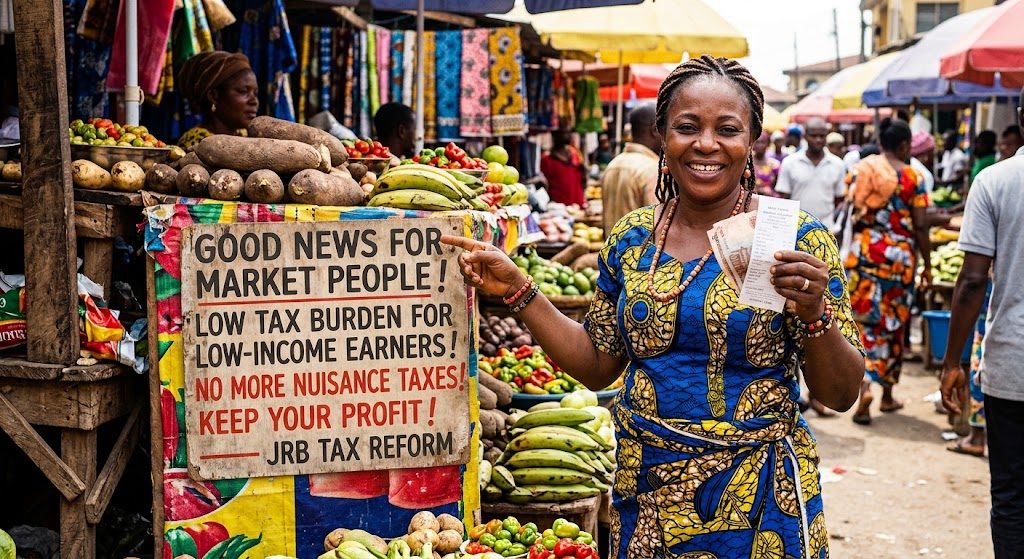
Freeing Traders from Street Harassment and Illegal Taxes
For many years, market women, traders, and drivers carrying farm goods suffered at the hands of illegal task forces. Every morning along the highway or at market gates, different collectors would block the road, seize goods, and demand cash for all kinds of local tickets. The Joint Revenue Board, the head body for tax administration in Nigeria, has officially put an end to this. Under the ongoing national tax reform, it is strictly illegal for any revenue collector or local task force to set up roadblocks, stop vehicles carrying market goods, or demand physical cash payments on the street.
Speaking at the meeting of the Joint Revenue Board in Kaduna State, Governor Uba Sani emphasized that paying taxes should never feel like harassment or extortion. The goal of the reform is to build a modern system where compliance is simple, transparent, and voluntary. Instead of task forces chasing sellers around the market with paper tickets, approved revenue payments are moving to digital platforms. This digital shift ensures that rogue collectors cannot make up fake charges on the spot or pocket your hard-earned money.
To stop local councils from creating unauthorized fees, revenue leaders are harmonizing tax rules across the entire country. In the past, transporting yam, pepper, or clothes from one state to another meant paying different levies at every state border and local government boundary. Now, state governments are adopting a single, unified tax framework. This alignment ensures you pay only legally recognized charges, eliminating double taxation on the same goods.
How Revenue Growth Builds Better Markets for Everyone
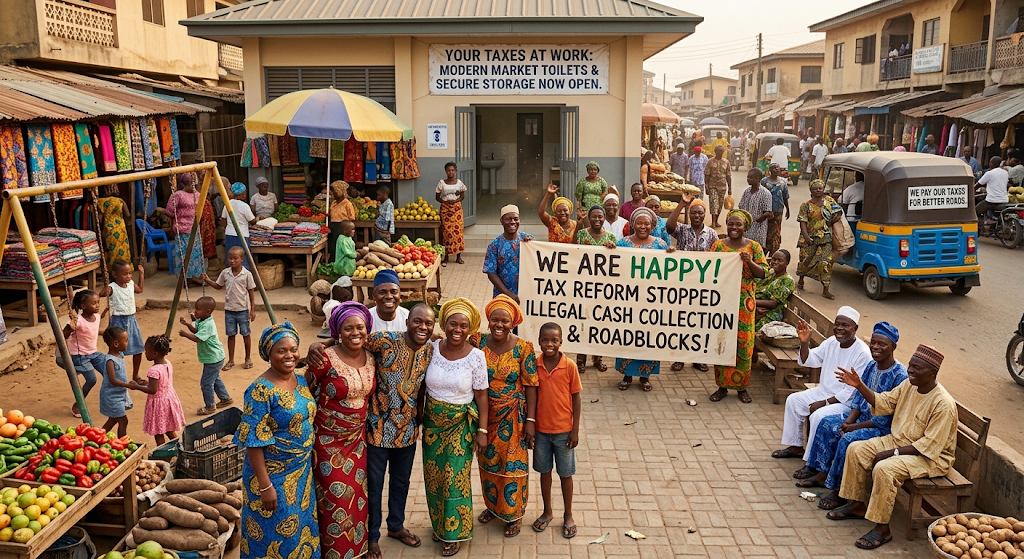
Happy Nigerian market traders
Traders often worry that when the government reports higher revenue figures, it means small market stalls are being squeezed harder. Governor Uba Sani cleared up this concern by sharing official national collection figures: tax revenue stood at approximately 10.1 trillion Naira in 2023, rose to 21.6 trillion Naira in 2024, and reached about 36.8 trillion Naira in 2025. This massive increase did not come from taxing low-income earners. Instead, it came from plugging corruption leakages, introducing digital tracking, and ensuring large corporations pay their fair share.
Revenue administration leaders, including JRB Chairman Dr. Zacch Adedeji, stressed that the true measure of any tax reform is how much it improves daily life and national development. When public revenue is collected cleanly, the government has the funds needed to build smooth roads connecting rural farm settlements to city markets. Good roads ensure farm produce arrives fresh without spoiling in transit, saving traders from costly losses. These funds also go directly into upgrading local market infrastructure with proper drainage, security, electricity, and clean water.
The Executive Secretary of the JRB, Olusegun Adesokan, reaffirmed that the reform is designed to give taxpayers a far better experience. As a market woman or small business owner, you have the legal right to trade without intimidation. If unauthorized collectors demand physical cash or attempt to block your goods on the road, know that national law protects you. By staying informed and working alongside your local market unions, traders can ensure these new protections are fully respected in every market across the country.
KADUNA — Kaduna State Governor, Senator Uba Sani, has lauded the ongoing national tax reforms, pointing to their success in eliminating double taxation while significantly boosting revenue generation across the country.
Speaking on the financial impact of the policy introduced under President Bola Tinubu, Governor Sani highlighted a dramatic upward trajectory in national collections. According to figures presented by the governor, total national revenue rose from approximately ₦10.1 trillion in 2023 to ₦21.6 trillion in 2024, before climbing to nearly ₦36.8 trillion in 2025.
The remarks were delivered during the Joint Revenue Board (JRB) meeting, where tax administrators gathered to review operational strategies. Representing JRB Chairman Dr. Zacch Adedeji, the Executive Director of Finance and Corporate Services at the Nigeria Revenue Service, Muhammad Abubakar, framed the session as a vital opportunity for revenue authorities to assess performance, resolve administrative gaps, and confront emerging sector challenges.
Abubakar stressed that the ultimate benchmark of the reform’s success extends beyond bottom-line figures, emphasizing that improved revenue mobilization must go hand-in-hand with greater compliance, a smoother taxpayer experience, and measurable contributions to national development.

